SYLVIE COURVOISIER TRIO
SYLVIE COURVOISIER, piano
KENNY WOLLESEN, drums & Wollesonics
DREW GRESS, bass
coming TOUR November 12–28, 2027
Albums
-
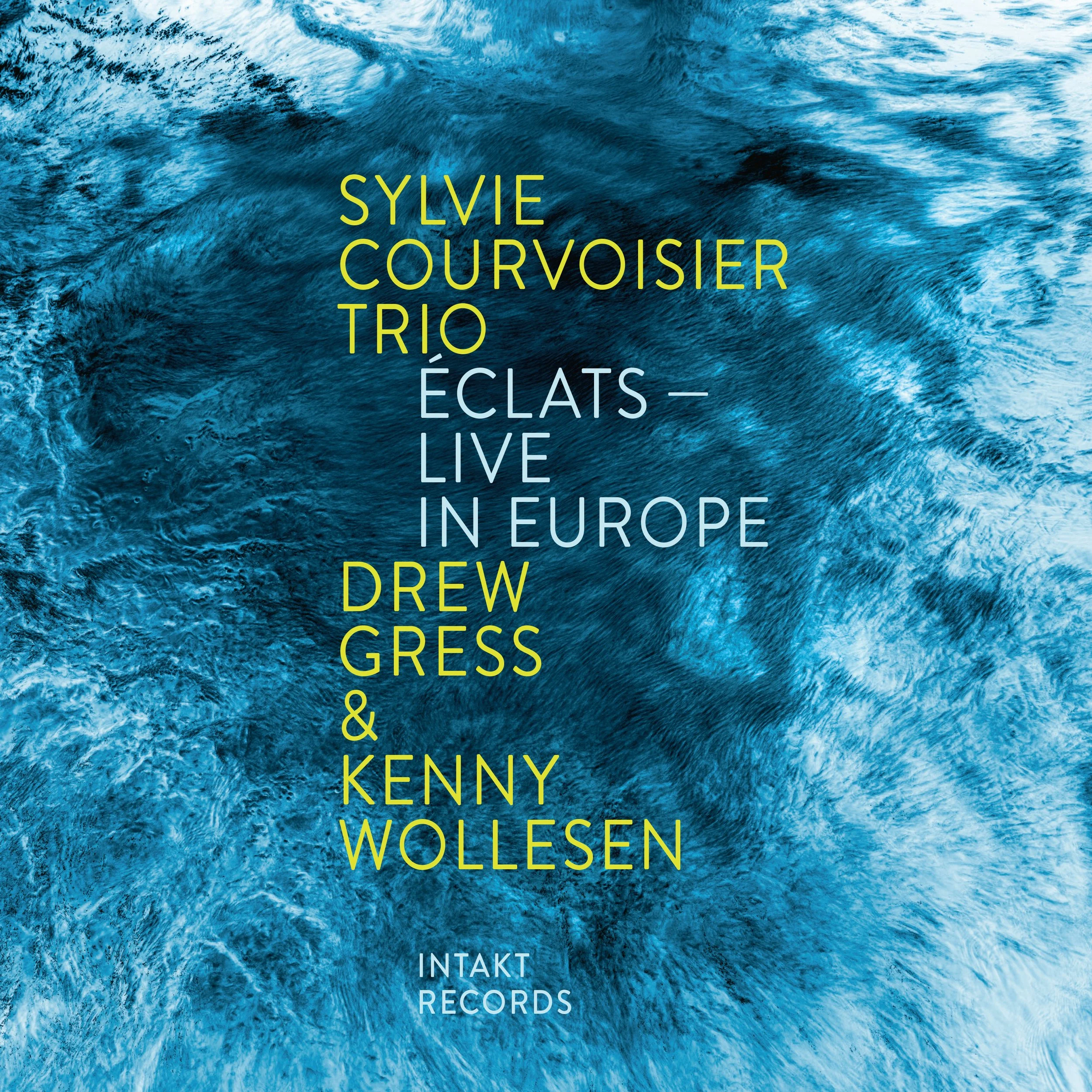
Éclats - Live in Europe
2026
-

FREE HOOPS
2020
-

D'AGALA
2018
-
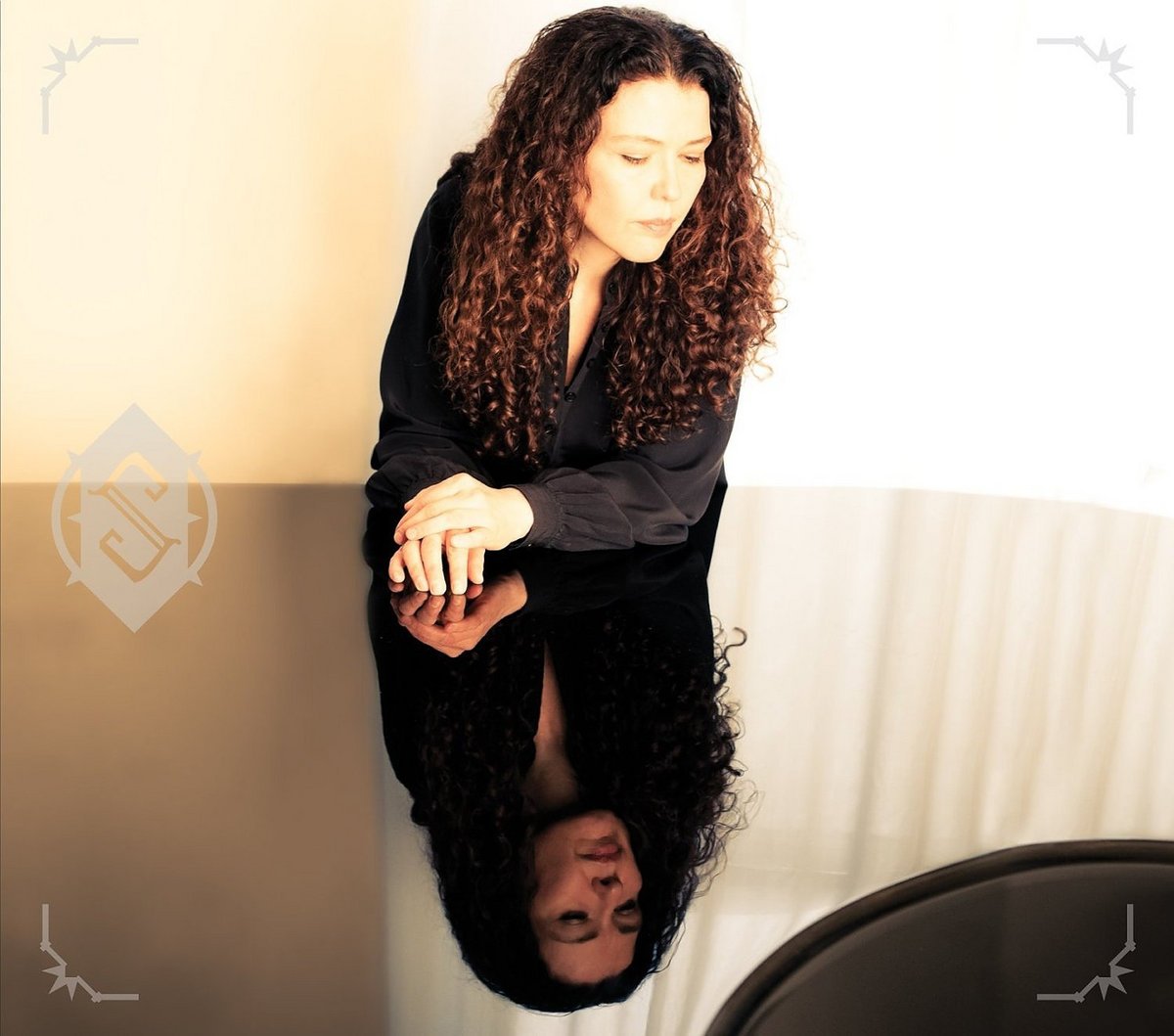
Double Windsor
2014
FREE HOOP Recorded on December 20th, 2019. Film: Mimi Chakarova.
About five years ago, I reviewed Free Hoops, the latest release by the Sylvie Courvoisier Trio. I also commented on a fine, pandemic-era livestream of the trio in concert at Roulette in New York.
Pianist Courvoisier has been busy since then, releasing sterling duet recordings with the likes of Wadada Leo Smith (Angel Falls) and Mary Halvorson (Bone Bells). But the 57-year-old Swiss native is now back with the trio disc Éclats — Live in Europe, a session that features her partners of a dozen years, Drew Gress on bass and Kenny Wollesen on drums and “Wollesonics,” the latter a technique which, alongside the leader’s audible forays inside the piano, produces intriguing atmospheric moments.
The all-original Courvoisier pieces selected for Éclats were drawn from three live European performances in 2025. Most of the nine compositions have previously appeared on studio recordings, but the threesome’s interactive (and unpredictable) musicality continues to have its special virtues. The group’s ability to introduce shards of free playing into implied structures (and vice versa) is consistently intriguing—and satisfying.
“Big Steps Toward Silence” starts with a bit of agitation before the piano undertakes a series of pensive lopes. Gress is particularly impressive throughout this release, here dancing with the pianist, who at times supplies a quiet, lyrical center. A heavier pulse eventually inserts some drama, with a Wollesen solo elevating the interplay via start-and-stop episodes. A pervasive quality of searching underlies this composition, leading to a quiet finish.
“Just Twisted” is an avant-garde burner that walks you into an imaginary joint jumping with deconstructed rhythms and pianistic onslaughts. “Downward Dog” resonates with a simmering restlessness à la the late Chick Corea (a musician you may think of occasionally as you hear Courvoisier pick a melody apart). Wollesen’s solo caps off a risky/frisky piece that might have gone on a while longer.
“Éclats for Ornette” carries the free-bop flag into blues territory. Courvoisier has carefully studied the master. “Imprint Double” portends an eruption: Courvoisier mingles a down-and-dirty riff with splashes of high notes that hover above a Gress solo. The payoff is the arrival of a marching passage that treats the piece’s opening motif in a more swinging manner. Another important release from this brilliant, longstanding threesome.
— Steve Feeney, The Arts Fuse, May 2 2026
... Even among the headliners, the trio of pianist Sylvie Courvoisier, bassist Drew Gress and drummer Kenny Wollesen stood out. A unit for some ten years, the band exhibits an uncanny chemistry. They remain simultaneously tight yet loose, navigating melodic fragments in unlikely places, delivering explosive flurries and making abrupt detours. Although it’s a repertoire they have toured for several years, they continue to uncover new facets, finding thrilling opportunities for group interplay and unexpected pockets for individual expression. Gress frequently demonstrated why he is in such demand, as he combined a finely honed lyric sense with impeccable timing, while Wollesen embellished and implied the beat as much as playing it. Courvoisier shifted seamlessly between keys and interior preparations, as volatile as her compositions, ever ready to unleash forearms and backs of hands when the moment required it, in a set that was variously combustible, solemn and vivacious, sometimes within the space of a single number.
— John Sharpe, ULRICHSBERG KALEIDOPHON
THE SYLVIE COURVOISIER TRIO BALANCE ALL THE ELEMENTS
The Sylvie Courvoisier Trio are disciplined, but they also know how to groove and make their playfulness a delight that relates to the more romping side of jazz history.
— Will Layman, Popmatters.com, 9 April 2026
With every concert and every album this glorious trio's modus operandi becomes more clear – Sylvie Courvoisier, Drew Gress and Kenny Wollesen play morphing music by turns intricately detailed and ambiguously wide open. The music Courvoisier writes is rigorously organized and calls for ensemble precision, as a few thorny unisono heads demonstrate. But the music also harbors a misterioso, dreamlike quality that may surface at any time, induced by a wistful ostinato or moonlit piano arpeggio stubbornly repeated, or by a quiet episode that underscores the depth of the trio's sonic space.
They also do that good stuff we prize jazz for – the happy swing-ing, the coming together when they make complex material sing, and the flying apart when the players explore it on their own.
Some pianists approach the instrument like it's a cathedral - Sylvie Courvoisier treats it like a playground." So observed Kevin Whitehead in the notes to the Sylvie Courvoisier Trio's D'Agala (Intakt), an album selected as one of the year's best by both The New York Times and Los Angeles Times in 2018. Previously, Double Windsor (Tzadik) the first album recorded by Courvoisier in league with bassist Drew Gress and drummer Kenny Wollesen - had been named best album of 2014 by Slate and New York City Jazz Record, along with receiving the "CHOC" from Jazz Magazine and Jazzman in France. In his notes to Free Hoops - this virtuosic trio's latest album, due in September 2020 from Intakt - Whitehead goes into detail about the range of atmosphere explored by Courvoisier and company: "The music harbors a misterioso, dreamlike quality... induced by a wistful ostinato or moonlit piano arpeggio, or by a quiet episode that underscores the depth of the trio's sonic space, as when a slapped-strings piano bass cluster explodes into the void. They also do that good stuff we prize jazz for: the happy swinging, the coming together when they make complex material sing." Courvoisier has earned just renown for balancing two distinct worlds: the richly detailed depth of her European chamber-music roots and the grooving, hook-laden sounds of the downtown jazz scene in New York City, her home now for two decades. Beyond her trio with Gress and Wollesen, the Swiss pianist's partnership with violinist Mark Feldman - lauded on both sides of the Atlantic - has yielded a long-running duo, as well as a top quartet. Over the years, Courvoisier has also worked with such avant-jazz luminaries as John Zorn, Wadada Leo Smith, Yusef Lateef, Evan Parker, Ikue Mori, Ellery Eskelin, Susie Ibarra, Fred Frith and Mary Halvorson.
— Bradley Bambarger
One of the most creative pianists in the downtown scene, and a long time collaborator of Mark Feldman, Ikue Mori and many others, Sylvie combines a brilliant technique with a wild imagination that straddles classical, jazz, improvisation and more. Featuring the dynamic rhythm section of Kenny Wollesen and Drew Gress, the music combines the best of improvisation and composition in the classic piano trio format. Three years in the making this is an essential project that highlights an exciting new musical world.
— John Zorn
recent Reviews
Éclats - Live In Europe, the fourth recording by Sylvie Courvoisier’s trio with bassist Drew Gress and drummer Kenny Wollesen, documents the outfit at a point where structure and spontaneity have become nearly indistinguishable. The album artfully stitches together excerpts from three dates in early 2025, while maintaining a consistent sonic ambience and the continuity of a single performance. It presents nine Courvoisier compositions, all but one drawn from the group’s previous three outings, including some of the pianist’s most memorable tunes in what could pass as a greatest hits compendium.
Even in normal circumstances, Courvoisier’s writing teems with catchy hooks, abrupt switchbacks and sudden suspensions. After six years of touring this repertoire following 2020’s Free Hoops, the trio has internalized the material to the point where the charts function more as points of departure than fixed forms. As a consequence the renditions here bear scant resemblance to the original versions, thematic framing aside. Nor are they alternate codifications. Having been lucky enough to witness the threesome several times in recent years, I can attest that they treat the pieces as organic entities, freshly minted on each occasion, kaleidoscopic in reach.
The title cut, one of the pianist’s flagship numbers, which has appeared in multiple guises over the years, furnishes a case in point. Dedicated to Ornette Coleman, it echoes the saxophonist’s vivacity, but views it through a distinctly exploratory lens. After the sprightly head, a lyrical bass and drum interlude settles into a walking groove. Courvoisier exploits this as a backdrop for a jaw-dropping display incorporating metal rubbed across strings, poltergeist taps, jazzy consonance, bluesy motifs, Cecil Taylor-like energy and articulation, and hyperspeed runs which suggest Conlon Nancarrow at his most ambitious. Her ability to meld real-time piano preparations and disparate styles into a cohesive whole brooks no rivals. In one exceptional passage she makes the strings veritably moan, eliciting sympathetic bass slurs from Gress. All of it unfolds in just over six minutes, on almost the shortest track.
At times such adventures generate formidable momentum. Gress exerts a mastery of melody and motion, combining them into an elastic flow, while Wollesen takes care of business without neglecting pitch and timbre. Yet although they tether the trio to the tradition, they remain alert to opportunities to subvert it. Foot-tapping or head nodding are likely to lead to dislocation. Form dissolves in an instant, only to miraculously reassemble Terminator-like and carry on as if nothing has happened. Bass and drums shine through gaps in the luxuriant surrounding foliage, whether cleared purposely or occurring by serendipity is a moot point. False endings and teasing feints, in which incipient solos suddenly vanish, render futile any attempt to distinguish scored interventions from collective improvisation.
Gems stud the program. “Just Twisted” takes on the contours of a drum concerto, Wollesen stretching out alone and later atop a rippling piano figure, amid the emphatic flourishes, slashing boogie-woogie and darting clusters. On the kinetic “Imprint Double” Courvoisier essays a dazzling series of glissandos before slotting back into a stomping beat. Gress introduces “South Side Rules” with a singing arco serenade. “Lulu’s Dance” receives a spare pointillist reading, taking its cue from the clipped high notes interpolated into the rolling theme, and providing a platform for the clacks and clangs of the drummer’s homemade “Wollesonics.”
Few working bands move so comfortably between swing, abstraction and chamber-like detail while sounding this wholly engaged with the moment. Among a slew of strong releases, this stands as one of Courvoisier’s finest.
–John Sharpe, pointofdeparture.org
Pianist Sylvie Courvoisier has been leading a trio with bassist Drew Gress and drummer Kenny Wollesen for about a decade now. They debuted on 2018’s D’Agala, returned on 2020’s Free Hoops and expanded to a sextet on 2023’s Chimaera, adding trumpeters Wadada Leo Smith and Nate Wooley and guitarist/electron ic musician Christian Fennesz to the ensemble. This live album, which pulls from three February 2025 performances in France and Germany, is the sound of a deeply connected set of players who know each other very well and can create music of extraordinary power with out ever relying on clichés or rote routines to get through a rough patch. The set list includes four tracks from D’Agala, three from Free Hoops and “Downward Dog” from Courvoisier’s 2014 album Birdies For Lulu, plus one new piece, “Big Steps Towards Silence.” What makes this trio so exciting is the seamless way they flow from hard swing, verg ing on boogie-woogie at times, to eerie, stark chamber music abstraction, including per cussive effects from Gress and Wollesen that sound more like a haunted house than a jazz rhythm section. Courvoisier, meanwhile, can lay down rich, full piano melodies that explode across the lis tener’s mind like time-lapse footage of flow ers blooming, then sound like a chisel tapping marble, or pick at the piano’s strings, the next. But at every moment, the feeling that comes through most powerfully is joy. Everyone here is having a blast, thrilled by what the other two are adding to the music moment by moment.
—Phil Freeman, Downbeat Jazz, may 2026
The word that captures the Sylvie Courvoisier Trio best is “balance”. The challenge of jazz as we head into the second quarter of the new century is how it will reconcile competing influences. Halfway through its history, the music had shed lots of structure — harmonic rules, 4/4 swing as a rule, the “head, solos, head” arrangement for performances, even the requirement of pre-determined composition itself — and the question became, how will great musicians balance the available extremes? Courvoisier, Gress, and Wollesen answer the call with graceful balance.
-By Will Layman, popmatters.com, 9 April 2026
About five years ago, I reviewed Free Hoops, the latest release by the Sylvie Courvoisier Trio. I also commented on a fine, pandemic-era livestream of the trio in concert at Roulette in New York.
Pianist Courvoisier has been busy since then, releasing sterling duet recordings with the likes of Wadada Leo Smith (Angel Falls) and Mary Halvorson (Bone Bells). But the 57-year-old Swiss native is now back with the trio disc Éclats — Live in Europe, a session that features her partners of a dozen years, Drew Gress on bass and Kenny Wollesen on drums and “Wollesonics,” the latter a technique which, alongside the leader’s audible forays inside the piano, produces intriguing atmospheric moments.
The all-original Courvoisier pieces selected for Éclats were drawn from three live European performances in 2025. Most of the nine compositions have previously appeared on studio recordings, but the threesome’s interactive (and unpredictable) musicality continues to have its special virtues. The group’s ability to introduce shards of free playing into implied structures (and vice versa) is consistently intriguing—and satisfying.
“Big Steps Toward Silence” starts with a bit of agitation before the piano undertakes a series of pensive lopes. Gress is particularly impressive throughout this release, here dancing with the pianist, who at times supplies a quiet, lyrical center. A heavier pulse eventually inserts some drama, with a Wollesen solo elevating the interplay via start-and-stop episodes. A pervasive quality of searching underlies this composition, leading to a quiet finish.
“Just Twisted” is an avant-garde burner that walks you into an imaginary joint jumping with deconstructed rhythms and pianistic onslaughts. “Downward Dog” resonates with a simmering restlessness à la the late Chick Corea (a musician you may think of occasionally as you hear Courvoisier pick a melody apart). Wollesen’s solo caps off a risky/frisky piece that might have gone on a while longer.
“Éclats for Ornette” carries the free-bop flag into blues territory. Courvoisier has carefully studied the master. “Imprint Double” portends an eruption: Courvoisier mingles a down-and-dirty riff with splashes of high notes that hover above a Gress solo. The payoff is the arrival of a marching passage that treats the piece’s opening motif in a more swinging manner. Another important release from this brilliant, longstanding threesome.
— Steve Feeney,The Arts Fuse, May 2 2026